

Linear’s Growth Journey
Linear is one of today’s most notable software startups building high-quality, nuanced products. Starting out as an issue-tracking software, Linear has become a serious Jira challenger working with F500 and some of today’s most innovative companies.
Linear’s approach to company-building contradicts some of the blitzscaling playbooks startups look up to. Instead, Linear features negative lifetime burn, an all-remote experienced team, and incredible success that most recently led to a $82M Series C round at a $1.25B valuation.
Other interviews with the Linear team have covered their approach to product management or itereating on the perfect messaging.
For this conversation, I wanted to focus on the inner workings at Linear that would intrigue any Strategy & Operations leader.
On a personal note, as a fellow Chief of Staff, Zoe and I have been in touch since a few years, and it has been great seeing her excel at Linear.
From Tactical to Strategic: the evolving CoS role
Zoe joined Linear as employee #12 and first business hire. At such an early stage, tactical execution was the focus:
"Every day, my priorities were extremely clear because it was simply: what is the thing that's on fire that I need to get done today?"
Her early focus split between supporting the product team and ensuring leadership priorities were clear. In addition to that, Zoe took care of ad-hoc items such as hiring when no Talent team was in place yet, and operational items such as Finance, Accounting, Billing.
Today, with a team of almost 100 employees working entirely remote, her focus has shifted to providing unique strategic insights:
"Now it's much more about pausing to be strategic. I'm often thinking about when it makes sense to hire a team for some of the things I'm doing, or whether we as a leadership team are making the right trade-offs in our decisions."
Despite the scaled organization, some of Zoe’s core responsibilities have remained constant: all-hands meetings, investor relations, board preparation, and company planning. Overall, however, with more functional leaders at Linear, she has moved from direct ownership to facilitating the right conversations.

Company-Building at Linear
Hiring Approach and Team Philosophy
From the early days, Linear has been intentional about both what they build and how they build. With a fully remote team already pre-pandemic, Linear’s co-founders set out a clear vision for the company culture they wanted to establish:
"From the very early days, we were looking for people who cared about their craft, were low ego, could flex into different areas, and didn't have strong feelings about what they were working on or their titles."
Essentially, Linear was indexing on self-starters who excelled in their field and cared about their craft, with no place for micromanaging:
"We work in really small teams and independently, sometimes project teams of one or two people. You need to be motivated and know how to unblock yourself. We don't expect extremely fast responses from people, so sometimes it'll take a day to hear back. You need to not be stifled and keep making progress."
Linear established work trials early on as part of their interview process, aiming for a high conversion rate from trial to offer. Throughout a work trial, the Linear team and the applicant work on a real-life project to assess mutual fit:
“We get a lot of insight from candidates that way, and it helps kickstart onboarding as well.”
Staying Lean
As Linear has evolved from issue-tracking tool to enterprise-grade project management software, it has stayed incredibly lean. With the latest Series C funding round, the Linear team is about to cross the 100-employee mark. While the overall trend in startup team size is trending downward, Linear champions succeeding with a proportionally small team.
One of the key metrics Linear tracks is revenue per employee.
"You never want that number to drop. It's not a perfect metric, but ideally, it grows or accelerates over time. We don't get less efficient as a business, which is sometimes counterintuitive for VC-backed startups."
According to Zoe, this philosophy creates "healthy pressure" on every hire:
"Our CEO asks great questions about understanding the person's day-to-day: who they work with, what they are going to do, what value they are going to bring. We really understand what skill sets they're going to unlock for our business."
The approach has evolved slightly as they've grown, but the core principle remains: every hire must demonstrate to increase the company's efficiency, not just its headcount.
Running Linear
Focusing on what matters
Linear’s operational philosophy mirrors their hiring approach of having a lightweight process with maximum clarity. The team does not use quarterly OKRs, extensive KPI dashboards, or rigid weekly business reviews. Instead, they rely on bi-annual planning cycles in the fall and spring, focusing on big milestones while staying flexible.
"We never set a plan in stone that's hard to change or immovable. Our plans are quite intuitive. If you ask anyone who's a leader on our product team, they could tell you off the top of their head what the next few months, maybe even a year or longer, would look like."
Linear’s key to success is to keep planning transparent while limiting involvement in decision-making to a small group. This approach requires deep trust with the leadership team, but it has ensured that the team remains strongly focused on what matters most.
In addition to large-scale company planning, monthly all-hands meetings provide deeper updates with demos, keeping the team aligned without over-managing the process.
CoS and COO: Two Distinct Roles
In 2023, Linear hired Cristina Cordova as COO to focus on revenue-generating functions. When Cristina joined as COO, Zoe had to navigate the classic Chief of Staff question: what is the overlap between both roles?
"The Chief of Staff role is to keep the leadership team as productive as possible, and that person is needed separately from the operations person, whose goal is to keep the company running efficiently."
In the case of Linear, Cristina focuses on go-to-market and revenue functions, while Zoe handles internal operations such as team operations, leadership priorities, Finance, HR, and compliance. However, as the company continues to scale, these responsibilities may shift:
"Sometimes the roles get conflated in early-stage companies, but they serve very different purposes. It's important to keep them as two different roles if you're able to."
AI at Linear
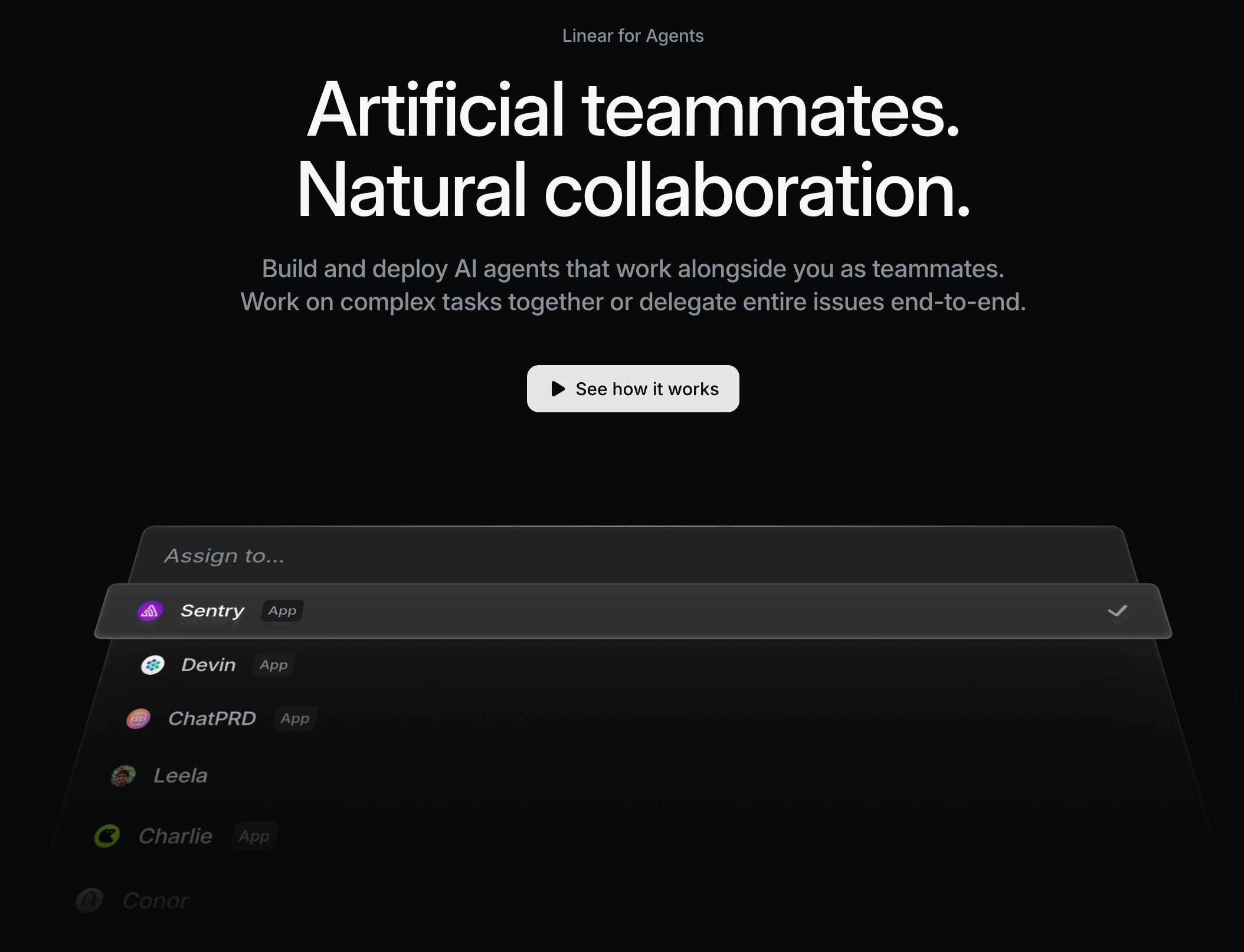
Linear works with some of the world’s most innovative AI companies such as OpenAI, Scale AI or Perplexity. In order to help them accelerate their software engineering efforts, the Linear team needs to understand those tools really well. The team launched Linear for Agents where AI agents function as real team members.
Linear encourages all team members, regardless of function, to experiment with AI tools. This internal adoption serves two reasons: it helps the team understand their own users better by experiencing firsthand where AI tools excel and where they still fall short. As Zoe explains:
"We're like a mini case study on what's going on in the rest of the industry. The AI coding tools tools are good, not great, still require a lot of manual review and sometimes can't do what you hope them to do. Some people are early adopters and use it side by side with their code every day and are more productive because of it. Some people are more unsure."
Advice for Fellow Operators
Asked for advice for fellow Operators and Chiefs, Zoe focuses on clarity and cutting out unnecessary distractions:
"You need to take a step back and know your top priorities. They're based on what's most important to your founders, which is based on what's most important to the business. That can cut your to-do list in half."
Chiefs are often exposed to some of the most sensitive topics inside an organization, both good and bad. Succeeding in the role for the long-term requires delegation and letting go:
"You can't let yourself get burned out. A big part of the role, if your company is growing, is being comfortable with giving up parts of the role. You're still one person, so as the company becomes more complex, you have to adapt."
Most importantly, since the effectiveness of a Chief of Staff role is heavily dependent on close relationships, with the executive team and beyond, Zoe encourages fellow Chiefs to over index on that:
"Building personal relationships with people on your leadership team is the most important thing you can do. It's about personalities and working well with people and building trust. That goes much further than business advice on how to be successful in the role."
Thank you
I hope you enjoyed this edition of The Operator.
Linear's approach to product and company-building offers valuable lessons for fellow Operators, and I hope this conversation with Zoe helped surface some of those insights.
Big thanks to Zoe for taking the time to share your Chief of Staff journey and learnings with us!
See you soon,
Jan
I love this collab!